HyDE Retrieval
HyDE improves RAG and memory retrieval by generating a hypothetical answer before embedding. Instead of embedding the raw user query, HyDE first asks an LLM to produce a plausible answer, then embeds that answer for vector search. The hypothesis is semantically closer to actual stored documents than a question is, yielding better recall.
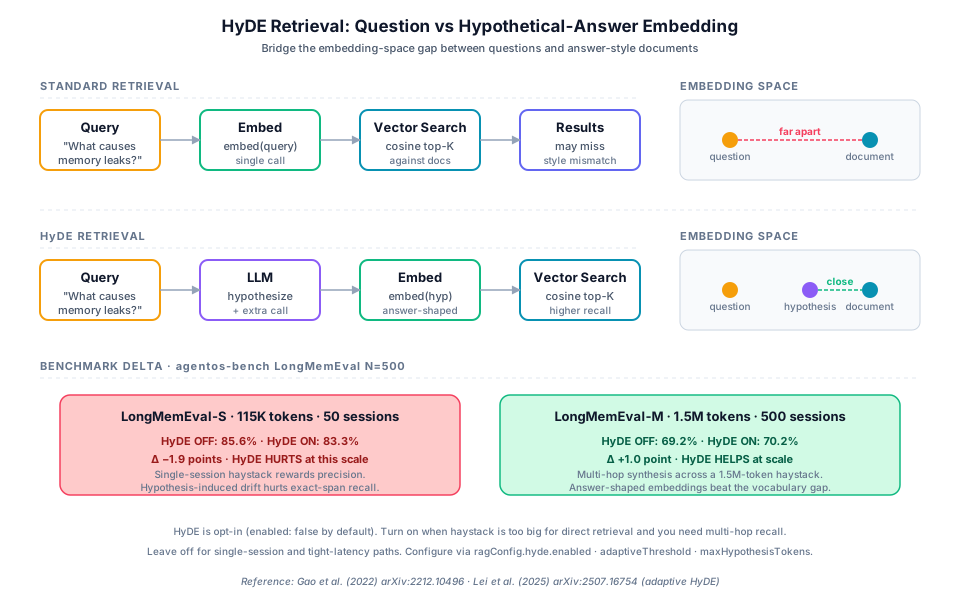
HyDE is opt-in (enabled: false by default). The
agentos-bench runs measured it
both ways:
- LongMemEval-S (115K tokens, 50 sessions): the 85.6% headline configuration runs with HyDE off. In a 54-case probe of the bench's reader-router configuration, adding HyDE scored 83.3% against 85.2% without it (-1.9 points).
- LongMemEval-M (1.5M tokens, 500 sessions): the 70.2% headline configuration runs with HyDE on. The same run without HyDE scored 69.2% (-1.0 point, with overlapping confidence intervals) at an average of 35 seconds a case against 84. By category, HyDE added 5.3 points on multi-session questions and cost 3.9 on knowledge-update questions.
Rule of thumb: turn HyDE on for multi-session questions over a haystack far
larger than the answer model's context window, and leave it off at S scale and
on tight-latency paths. The ablation rows are in the bench repository's
results/LEADERBOARD.md
and
results/eval-matrix-v1/transparency-notes.md.
Based on:
- Gao et al. (2022). Precise Zero-Shot Dense Retrieval without Relevance Labels. arXiv:2212.10496.
- Lei et al. (2025). Never Come Up Empty: Adaptive HyDE Retrieval for Improving LLM Developer Support. arXiv:2507.16754.
How It Works
Standard:  Query --> Embed(query)       --> Vector Search --> Results
HyDE:     Query --> LLM(hypothesis)    --> Embed(hypothesis) --> Vector Search --> Results
                    ^                         ^
                    Extra LLM call            Better semantic match
The key insight: questions and answers live in different regions of embedding space. A question like "What causes memory leaks in Node?" is far from the answer text "Memory leaks in Node.js are caused by...". But a hypothetical answer generated from the question is much closer to the stored answer, producing higher cosine similarity scores.
When to Use HyDE
Good candidates:
- Knowledge base queries where the question phrasing differs from document style
- Vague or exploratory queries ("that thing about deployment")
- Memory recall where stored traces are statement-form, not question-form
- Background/batch processing where latency is less critical
Avoid when:
- Real-time chat with tight latency budgets (adds one LLM call per query)
- Simple keyword-style lookups where direct embedding already works well
- The query is already in statement/answer form
Configuration
HyDE has no global switch: each integration turns it on per call, as shown below. HydeRetriever and its config types are exported from @framers/agentos/cognition/rag. A HydeRetriever takes this config:
| Option | Type | Default | Description |
|---|---|---|---|
enabled | boolean | false | Read by callers through retriever.enabled |
initialThreshold | number | 0.7 | Starting similarity threshold for retrieve() |
minThreshold | number | 0.3 | Lowest threshold retrieve() steps down to |
thresholdStep | number | 0.1 | How much retrieve() lowers the threshold per step |
adaptiveThreshold | boolean | true | Step down while a search returns nothing |
maxHypothesisTokens | number | 200 | Written into the prompt as a length limit; not sent as a token cap |
hypothesisSystemPrompt | string | a short "answer factually, with technical terms" prompt | System prompt for hypothesis generation |
fullAnswerGranularity | boolean | true | Ask for prose answers rather than the shortest answer |
hypothesisCount | number | 3 | Hypotheses per query in retrieveMulti() and generateMultipleHypotheses() |
Programmatic API
1. RetrievalAugmentor (main RAG pipeline)
import { RetrievalAugmentor } from '@framers/agentos/cognition/rag';

// Stand-ins. Replace with your real EmbeddingManager / VectorStoreManager
// instances and a RetrievalAugmentorConfig your runtime provides.
declare const config: any;
declare const embeddingManager: any;
declare const vectorStoreManager: any;
declare const openai: any;

const augmentor = new RetrievalAugmentor();
await augmentor.initialize(config, embeddingManager, vectorStoreManager);

// Register an LLM caller for hypothesis generation
augmentor.setHydeLlmCaller(async (systemPrompt, userPrompt) => {
  const response = await openai.chat.completions.create({
    model: 'gpt-4o-mini',
    messages: [
      { role: 'system', content: systemPrompt },
      { role: 'user', content: userPrompt },
    ],
    max_tokens: 200,
  });
  return response.choices[0].message.content ?? '';
});

// Enable HyDE per request
const result = await augmentor.retrieveContext('What causes memory leaks?', {
  hyde: {
    enabled: true,
    // Optional: supply a hypothesis to skip the LLM call
    // hypothesis: 'Memory leaks are caused by...',
  },
});

console.log(result.diagnostics?.hyde);
// { hypothesis, hypothesisLatencyMs, effectiveThreshold: 0.7, thresholdSteps: 0 }
The augmentor generates one hypothesis, embeds it in place of the query and runs its normal search with that vector. It does no threshold stepping: diagnostics.hyde reports the configured initialThreshold and thresholdSteps: 0. A retrieval policy with hyde: 'always' turns HyDE on without options.hyde.
2. MultimodalIndexer (cross-modal search)
import { MultimodalIndexer, HydeRetriever } from '@framers/agentos/cognition/rag';

// Stand-ins for the host-supplied dependencies.
declare const embeddingManager: any;
declare const vectorStore: any;
declare const visionProvider: any;
declare const myLlmCaller: any;

const indexer = new MultimodalIndexer({
  embeddingManager,
  vectorStore,
  visionProvider,
});

indexer.setHydeRetriever(new HydeRetriever({
  llmCaller: myLlmCaller,
  embeddingManager,
  config: { enabled: true },
}));

// Search with HyDE: HydeRetriever.retrieve(), with adaptive thresholds
const results = await indexer.search('architecture diagram', {
  modalities: ['image'],
  hyde: { enabled: true },
});
3. CognitiveMemoryManager (memory recall)
initialize() builds a memory HyDE retriever from the first LLM invoker the config has (the reflector's, the observer's, then featureDetectionLlmInvoker); setHydeRetriever() replaces it.
import { CognitiveMemoryManager } from '@framers/agentos';

// Stand-ins for the host-supplied dependencies.
declare const config: any;
declare const currentMood: any;

const memoryManager = new CognitiveMemoryManager();
await memoryManager.initialize(config);

const result = await memoryManager.retrieve(
  'that deployment discussion',
  currentMood,
  { hyde: true },
);
With hyde: true (or a retrieval policy with hyde: 'always'), the manager asks for a hypothesis to "Recall a memory about:
4. Standalone HydeRetriever
import { HydeRetriever } from '@framers/agentos/cognition/rag';

declare const embeddingManager: any;
declare const myVectorStore: any;

const retriever = new HydeRetriever({
  llmCaller: async (system, user) => {
    // Call your model with the system and user prompts; return its text.
    return 'Retrieval-augmented generation retrieves documents and adds them to the prompt...';
  },
  embeddingManager,
  config: { adaptiveThreshold: true, initialThreshold: 0.7, minThreshold: 0.3 },
});

// Generate a hypothesis only
const { hypothesis, latencyMs } = await retriever.generateHypothesis(
  'What is retrieval augmented generation?',
);

// Full retrieve cycle with adaptive thresholding
const result = await retriever.retrieve({
  query: 'What is RAG?',
  vectorStore: myVectorStore,
  collectionName: 'knowledge-base',
});

// Several hypotheses from one LLM call, searched in parallel and merged
const multi = await retriever.retrieveMulti({
  query: 'What is RAG?',
  vectorStore: myVectorStore,
  collectionName: 'knowledge-base',
});
retrieveMulti() keeps the highest score per document and returns the top
queryOptions.topK (5 by default). It applies no similarity threshold and
does no threshold stepping. When the model's reply does not split into the
requested number of hypotheses, the retriever makes one more call per missing
hypothesis.
5. Other callers
UnifiedRetriever: with ahydeRetrieverdependency, it runs HyDE when the retrieval plan hashyde.enabled. The default plans turn it on for themoderatestrategy (one hypothesis) and thecomplexstrategy (three).- The memory
HybridRetriever: with thehydeRetrieveroption, a hypothesis replaces the query for the dense and sparse searches, and the reranker keeps the original query. QueryRouter: the built-in router generates no hypothesis. Its T2 and T3 searches run the router's plain vector search unless aUnifiedRetrieverbuilt with ahydeRetrieveris attached withsetUnifiedRetriever().
Adaptive Thresholding
HydeRetriever.retrieve() (used directly or by MultimodalIndexer) steps the
similarity threshold down while a search returns nothing, until it finds
content or would pass minThreshold. The augmentor and the memory manager do
not step.
Initial threshold: 0.7  -->  No results
Step down to:      0.6  -->  No results
Step down to:      0.5  -->  Found 3 results!  (stop here)
retrieve() returns effectiveThreshold and thresholdSteps, the number of steps it took.
Audit Trail
When includeAudit: true is passed to retrieveContext(), the augmentor's
HyDE step appears in the audit trail with operation type 'hyde':
const result = await augmentor.retrieveContext(query, {
  hyde: { enabled: true },
  includeAudit: true,
});

const hydeOp = result.auditTrail?.operations.find(
  (op) => op.operationType === 'hyde',
);
// hydeOp.hydeDetails.hypothesis
// hydeOp.hydeDetails.effectiveThreshold
// hydeOp.hydeDetails.thresholdSteps
// hydeOp.tokenUsage (estimated from text length: about 4 characters a token)
Performance Implications
| Metric | Without HyDE | With HyDE |
|---|---|---|
| LLM calls per query | 0 | 1 |
| Embedding calls | 1 | 1 (hypothesis instead of query) |
| Vector searches | 1 | 1, or up to one per threshold step in HydeRetriever.retrieve() |
| Added latency | 0 | one LLM generation |
The model is whatever the LLM caller you register calls.
Graceful Degradation
| Failure | RetrievalAugmentor | CognitiveMemoryManager | HydeRetriever / MultimodalIndexer |
|---|---|---|---|
| No LLM caller or retriever | direct query embedding, with a diagnostic message | raw query | (a retriever always has a caller) |
| The LLM call throws | the error propagates from retrieveContext() | raw query | the error propagates |
| The hypothesis embedding is empty | direct query embedding, with a diagnostic message | (the store embeds the text) | empty result |
| No results at any threshold | (no stepping) | (no stepping) | empty result |