System Architecture
AgentOS organizes the runtime around long-running agent state rather than around a single turn loop. Cross-session conversations, parallel agent instances with independent personality and memory, conditional tool execution, human-in-the-loop approval, and a memory layer that distinguishes verified user input from model-generated content are first-class subsystems with their own modules.
The 26 top-level modules documented below are predominantly state-management subsystems. The turn loop itself is one component among them, not the central abstraction.
This page is the system map. For the what of each subsystem — components, lifecycle ownership, source-tree location — read on. For deep-dives into individual concerns, follow the table of contents.
For specific subsystem deep-dives, see:
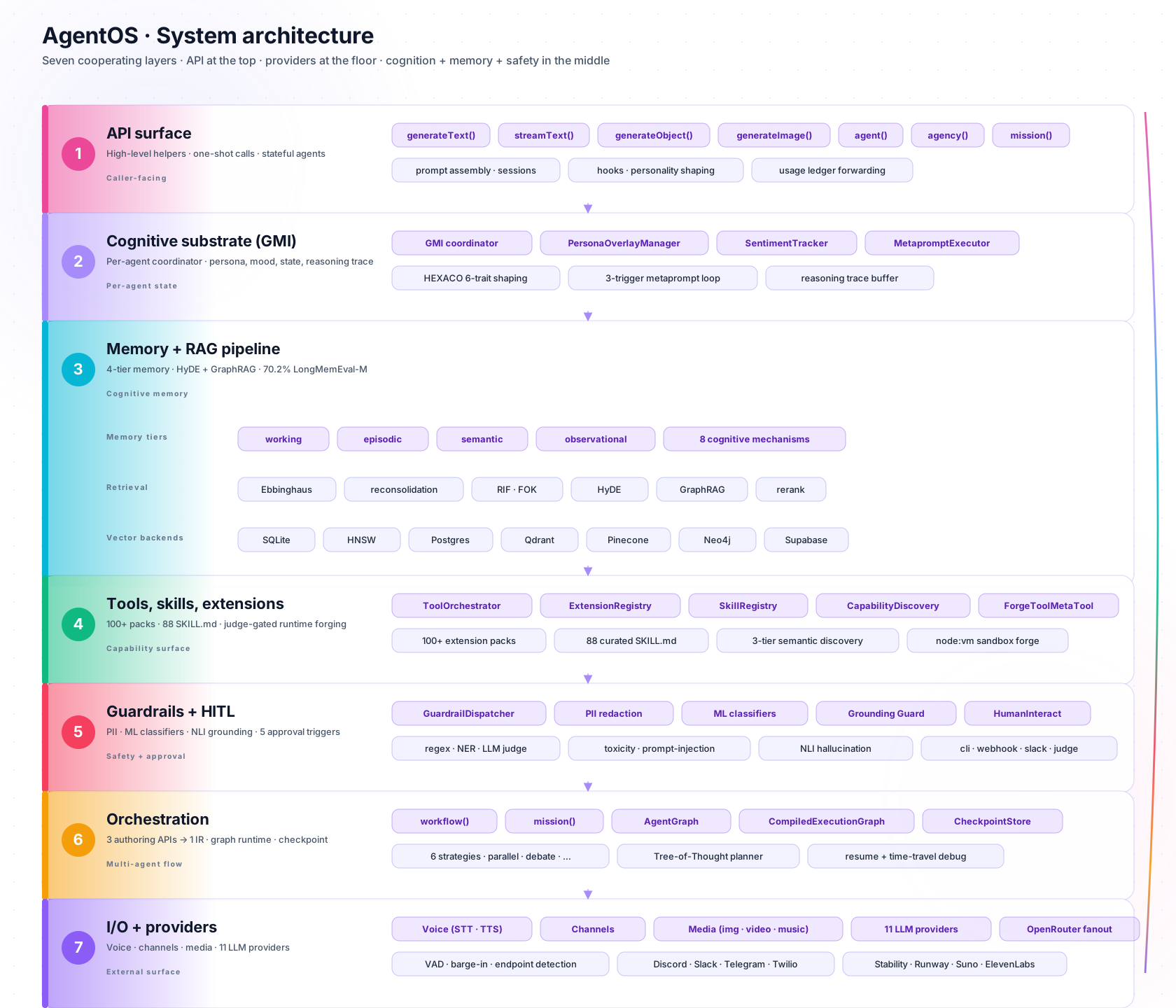
Each layer above corresponds to a section below. The mapping is one-to-one: layer 1 → API Surface Contract, layer 2 → GMI, layer 3 → Memory System, layer 4 → Tools, Skills, Extensions, layer 5 → Safety & Guardrails, layer 6 → Orchestration, layer 7 → Perception & Channels. The component pills inside each layer in the diagram are the same class and function names you'll see in the subsystem write-ups.
Source Directory Layout
The src/ tree is organized into 26 domain-specific top-level modules. Only foundational infrastructure remains under core/.
Perception model: Vision, hearing, and speech are separated into three independent modules following the biological perception analogy -- vision/ (OCR, scene detection, image analysis), hearing/ (STT providers, VAD, silence detection), and speech/ (TTS providers, resolver, session). Shared media generation (images, video, music, SFX) remains under media/.
Key architectural patterns:
-
GMI (Generalized Mind Instance) delegates to focused collaborators:
ConversationHistoryManager,CognitiveMemoryBridge,SentimentTracker, andMetapromptExecutor. Persona layering lives incognitive_substrate/persona_overlays/. Personas can be loaded from JSON (the legacyIPersonaDefinitionformat) or fromSOUL.mdworkspace directories viaSoulLoader(cognitive_substrate/personas/SoulLoader.ts) — both produce the same runtimeIPersonaDefinition. See SOUL_FILES.md for the per-agent identity convention. -
AgentOS is the public lifecycle facade. Setup and runtime concerns are in
api/runtime/(WorkflowFacade,CapabilityDiscoveryInitializer,RagMemoryInitializer). High-level helpers (generateText,streamText,agent,agency) live underapi/. -
AgentOSOrchestrator coordinates requests, delegating to
TurnExecutionPipeline(pre-LLM preparation),GMIChunkTransformer(stream mapping), andExternalToolResultHandler(tool-result continuation).
All paths below are under packages/agentos/src/.
| Module | Subdirs | Purpose |
|---|---|---|
agents/ | definitions/ · agency/ | Agent type definitions and multi-agent coordination (AgencyRegistry) |
api/ | runtime/ · types/ | Public API surface — AgentOS, generateText, streamText, agent, agency, orchestrator collaborators, provider defaults |
channels/ | adapters/ · telephony/ · social-posting/ | Platform adapters (Discord, Slack), voice-call providers (Twilio, Vonage), social-post management |
cognitive_substrate/ | personas/ · persona_overlays/ | The GMI itself plus ConversationHistoryManager, CognitiveMemoryBridge, SentimentTracker, MetapromptExecutor, and persona loaders (JSON + SOUL.md via SoulLoader) |
core/ | config/ · conversation/ · embeddings/ · llm/ · logging/ · rate-limiting/ · storage/ · streaming/ · tools/ · utils/ · vector-store/ | Foundational infrastructure: shared interfaces, the IStorageAdapter, the StreamingManager, the ITool / ToolOrchestrator, embedding and vector-store abstractions |
discovery/ | — | Capability-discovery engine (tiered semantic search) |
emergent/ | — | Runtime tool forging and self-improvement (forge_tool, EmergentCapabilityEngine, EmergentJudge) |
evaluation/ | observability/ | Eval framework + OpenTelemetry tracing and metrics |
extensions/ | — | Extension system: ExtensionPack, descriptor kinds, activation lifecycle |
hearing/ | — | Listening surface: STT providers, VAD, silence detection |
marketplace/ | store/ · workspace/ | Agent-marketplace listings + per-agent workspace helpers |
media/ | audio/ · images/ · video/ | Creative generation: image (DALL-E, Stability), video, music, SFX |
memory/ | core/ · io/facade/ · io/tools/ · mechanisms/ · pipeline/ · retrieval/ | Cognitive memory system: encoding/decay, the Memory API, memory tools, neuroscience-grounded mechanisms, consolidation, retrieval brain |
nlp/ | ai_utilities/ · language/ · tokenizers/ · stemmers/ · normalizers · lemmatizers · filters | NLP processing — LLM-backed summarization, language detection, tokenizers |
orchestration/ | planner/ · hitl/ · workflows/ · turn-planner/ · ir/ · compiler/ · runtime/ · checkpoint/ · events/ | DAG workflow engine, PlanningEngine (ReAct loops), human-in-the-loop, IR/compiler, event bus |
provenance/ | — | Content provenance + blockchain anchoring |
query-router/ | — | Query classification + routing |
rag/ | vector-search/ · vector_stores/ · chunking/ · reranking/ · unified/ · graphrag/ | Retrieval-augmented generation: HNSW sidecar, vector-store implementations, chunking strategies, reranking, graph-augmented retrieval |
safety/ | guardrails/ · runtime/ | Guardrails (IGuardrailService, ParallelGuardrailDispatcher) and runtime safety (CircuitBreaker, CostGuard, StuckDetector) |
sandbox/ | executor/ · subprocess/ | Sandboxed code execution (node:vm) and CLISubprocessBridge / CLIRegistry |
skills/ | — | SKILL.md loader (content lives in agentos-skills) |
speech/ | — | Speaking surface: TTS providers, resolver, session |
structured/ | output/ · prompting/ | Structured output (StructuredOutputManager, JSON schema) + prompt routing |
types/ | — | Shared types (auth) |
vision/ | — | Seeing surface: OCR, scene detection, image analysis |
voice-pipeline/ | — | Real-time voice-conversation orchestrator |
Architecture Layers
The diagram at the top of this page is the canonical layered view. From top to bottom:
- API surface —
generateText/streamText/agent/agency/generateImage, plus theAgentOSlifecycle facade. - Orchestration — DAG runtime,
workflow(),mission(),AgentGraph, HITL, checkpointing, planning engine. - GMI — per-mind state:
ConversationHistory,CognitiveMemoryBridge,SentimentTracker,MetapromptExecutor, persona overlays. - Safety & Guardrails alongside Tools & Extensions — 5-tier security (PII, toxicity, grounding, circuit breakers, cost guard) and the 110-extension / 88-skill catalog with capability discovery and runtime tool forging.
- Memory & RAG — 4-tier cognitive memory, 8 mechanisms (Ebbinghaus decay, retrieval-induced forgetting, …), 7 vector backends, HyDE, GraphRAG, hybrid retrieval,
CitationVerifier. - LLM providers — 11 direct providers + OpenRouter fan-out with automatic fallback chains.
- Perception & channels — vision (OCR), hearing (STT, VAD), speech (TTS, voice pipeline), 12 messaging adapters, telephony.
The diagram above the prose shows how a typical request enters at layer 1 and traverses downward.
API Surface Contract
generateText(), streamText(), agent(), agency(), and the AgentOS runtime share some configuration names, but the shared config surface does not imply identical enforcement.
agent()is the lightweight stateful facade for prompt assembly, sessions, tools, hooks, personality shaping, and usage-ledger forwarding.generateText()/streamText()are low-level helper loops for provider selection, direct tool execution, and text-fallback tool calling.- The full
AgentOSruntime andagency()own the deeper runtime systems: emergent tooling, guardrails, discovery, RAG bootstrapping, permissions/security tiers, HITL, voice/channels, and provenance-aware orchestration.
GMI (Generalized Mind Instance)
GMI is what an agent actually is between turns: persona, working memory, mood, reasoning trace, conversation history. Each instance is a single mind bound to one persona. The dedicated GMI page walks the seven-ring concentric model in detail — this section covers how the GMI plugs into the wider runtime.
GMI Lifecycle
Initialization
GMI.initialize(persona, config) validates required dependencies, wires collaborators, and loads state:
const gmi = new GMI('my-gmi-id');
await gmi.initialize(researchAssistantPersona, {
  workingMemory,
  promptEngine,
  toolOrchestrator,
  llmProviderManager,
  utilityAI,
  cognitiveMemory,       // Optional: enables CognitiveMemoryBridge
  retrievalAugmentor,    // Optional: enables RAG
});
Required dependencies: workingMemory, promptEngine, toolOrchestrator, llmProviderManager, utilityAI. Optional: cognitiveMemory, retrievalAugmentor.
Collaborators
The GMI delegates to four extracted collaborators to keep the core class focused:
| Collaborator | Responsibility |
|---|---|
ConversationHistoryManager | Maintains chat history, supports hydration from external stores |
CognitiveMemoryBridge | Bridges GMI turns to the CognitiveMemoryManager (encode/retrieve/observe) |
SentimentTracker | Tracks user sentiment via IUtilityAI, emits GMIEvent types (frustration, confusion, etc.) |
MetapromptExecutor | Handles metaprompt triggers, self-reflection, and state updates |
Turn Processing
processTurnStream() is an async generator that yields GMIOutputChunk objects:
for await (const chunk of gmi.processTurnStream(turnInput)) {
  switch (chunk.type) {
    case GMIOutputChunkType.TEXT_DELTA:     // Streaming text
    case GMIOutputChunkType.TOOL_CALL:      // Tool call request
    case GMIOutputChunkType.TOOL_RESULT:    // Tool execution result
    case GMIOutputChunkType.FINAL_RESPONSE: // Aggregated final output
    case GMIOutputChunkType.ERROR:          // Error during processing
  }
}
AgentOS Facade
AgentOS (api/AgentOS.ts) is the public-facing facade that manages GMI instances, streaming, and cross-cutting concerns. It exposes processRequest() as the primary entry point and coordinates:
GMIManager-- Pool of GMI instances keyed by persona/sessionAgentOSOrchestrator-- Turn preparation and stream transformationStreamingManager-- WebSocket/SSE stream multiplexingExtensionManager-- Tool, guardrail, and workflow extension loadingConversationManager-- Cross-session conversation persistence
AgentOSConfig is the comprehensive configuration object (~50 fields) that wires all subsystems together. Key optional features activated via config: ragConfig, turnPlanning, emergent, observability, standaloneMemory, workflowEngineConfig.
Request Lifecycle
A user request flows through the following stages:
- Authentication & Rate Limiting -- Validate auth context and check rate limits.
- Context Assembly -- Load session history, conversation context, and temporal/environmental state.
- GMI Selection -- Get or create a GMI instance for the user/persona/session tuple.
- Memory Retrieval --
CognitiveMemoryBridgeretrieves relevant memory traces; RAG retrieval runs if configured. - Prompt Construction --
MetapromptExecutorassembles system, persona, memory, RAG context, and conversation history into the prompt viaPromptBuilder. - Pre-execution Guardrails --
ParallelGuardrailDispatcherruns input guardrails (sanitizers first, classifiers in parallel). - Tool Orchestration --
ToolOrchestratorresolves and executes any tool calls selected by the LLM. - LLM Execution --
StreamingManagersends the prompt to the selected LLM provider and streams chunks. - Post-execution Guardrails -- Output guardrails evaluate the response (toxicity, PII, grounding).
- Memory Update --
CognitiveMemoryBridgeencodes new memory traces;MemoryObserverqueues background consolidation. - Analytics --
Tracerrecords OpenTelemetry spans; cost/token metrics are tracked.
The TurnExecutionPipeline (in api/runtime/) handles steps 2-6 before handing off to the LLM. GMIChunkTransformer maps raw LLM chunks into AgentOSResponse format. ExternalToolResultHandler manages tool-result continuation loops.
Sequence Diagram
The following sequence diagram traces a single request through the system:
Key Types
| Type | Module | Purpose |
|---|---|---|
AgentOSInput | api/types/ | Normalized request envelope (text, audio, images, metadata) |
AgentOSResponse | api/types/ | Streamed response chunks (TEXT_DELTA, TOOL_CALL, FINAL_RESPONSE, ERROR) |
GMITurnInput | cognitive_substrate/IGMI | Internal turn representation consumed by the GMI |
GMIOutputChunk | cognitive_substrate/IGMI | Per-chunk output from the cognitive engine |
ConversationContext | core/conversation/ | Session state: history, active persona, user context |
Extension & Guardrail Runtime
The extension runtime is centered on three core pieces:
ExtensionManifest/ExtensionPack-- Declarative loading of tool bundles, guardrails, and channel adapters.ExtensionManager-- Descriptor activation and runtime access.ISharedServiceRegistry-- Lazy singleton reuse across packs (for NLP pipelines, ONNX classifiers, embedding functions).
interface ExtensionPack {
  name: string;
  version?: string;
  descriptors: ExtensionDescriptor[];
  onActivate?: (context: ExtensionLifecycleContext) => Promise<void> | void;
  onDeactivate?: (context: ExtensionLifecycleContext) => Promise<void> | void;
}
Creating an Extension Pack
Extension packs are the unit of distribution. Each pack bundles one or more descriptors of the same or different kinds (tool, guardrail, workflow, provenance, etc.) and can hook into the activation lifecycle to perform setup and teardown.
import type { ExtensionPack, ExtensionLifecycleContext } from '@framers/agentos/extensions';
import { EXTENSION_KIND_TOOL } from '@framers/agentos/extensions';

export function createMyExtensionPack(): ExtensionPack {
  return {
    name: 'my-custom-tools',
    version: '1.0.0',
    descriptors: [
      {
        kind: EXTENSION_KIND_TOOL,
        tool: {
          id: 'my-search-tool',
          name: 'search_documents',
          displayName: 'Document Search',
          description: 'Search internal documents by query.',
          inputSchema: {
            type: 'object',
            properties: { query: { type: 'string' } },
            required: ['query'],
          },
          execute: async (args) => {
            const results = await searchIndex(args.query);
            return { success: true, output: results };
          },
        },
      },
    ],
    onActivate: async (ctx: ExtensionLifecycleContext) => {
      const apiKey = ctx.getSecret?.('MY_API_KEY');
      // Initialize resources, warm caches, etc.
    },
    onDeactivate: async () => {
      // Release resources
    },
  };
}
Packs are loaded by including them in the extensionManifest passed to AgentOS.initialize(), or by using the schema-on-demand meta-tools (extensions_list, extensions_enable) at runtime.
Descriptor Kinds
| Kind | Constant | Payload Field | Description |
|---|---|---|---|
tool | EXTENSION_KIND_TOOL | tool: ITool | Callable tool registered in ToolOrchestrator |
guardrail | EXTENSION_KIND_GUARDRAIL | guardrail: IGuardrailService | Input/output guardrail |
workflow | EXTENSION_KIND_WORKFLOW | workflow: WorkflowDescriptorPayload | Reusable workflow definition |
provenance | EXTENSION_KIND_PROVENANCE | provenance: IProvenanceProvider | Content anchoring provider |
Guardrail Dispatch Model
ParallelGuardrailDispatcher uses a two-phase execution model:
- Phase 1 (sequential sanitizers) -- Guardrails with
config.canSanitize === truerun in registration order and can chainSANITIZEresults deterministically. ABLOCKin Phase 1 short-circuits the entire pipeline. - Phase 2 (parallel classifiers) -- All remaining guardrails run concurrently via
Promise.allSettled. A Phase 2SANITIZEis downgraded toFLAGbecause concurrent sanitization would produce non-deterministic results.
The final outcome uses worst-wins aggregation: BLOCK (3) > FLAG (2) > ALLOW (0).
GuardrailOutputPayload carries ragSources?: RagRetrievedChunk[] so grounding-aware guardrails can verify claims against retrieved evidence.
Each guardrail service can also configure timeouts via config.timeoutMs. If a guardrail exceeds its timeout or throws, it fails open (returns null) rather than blocking the pipeline.
Built-in Guardrail Packs
Six built-in packs ship from packages/agentos-extensions/registry/curated/safety/:
pii-redaction— sanitizer; redacts personally identifiable information before tokens leave the runtimeml-classifiers— toxicity / hate-speech / harm classification via on-device ONNX modelstopicality— LLM-as-judge classifier that rejects off-topic / out-of-scope promptscode-safety— static + heuristic detection of dangerous code patterns in agent-emitted snippetsgrounding-guard— verifies output claims against retrieved RAG sources (citation faithfulness)content-policy-rewriter— sanitizer; rewrites policy-violating output in-place rather than blocking
For details on writing custom guardrails, see Creating Guardrails and Guardrails Usage.
Persona System
Personas define the identity, expertise, and behavioral configuration for a GMI instance.
Key files:
cognitive_substrate/personas/IPersonaDefinition.ts-- TheIPersonaDefinitioninterfacecognitive_substrate/personas/PersonaLoader.ts-- Loads persona JSON files from disk or registrycognitive_substrate/personas/PersonaValidation.ts-- Schema validationcognitive_substrate/persona_overlays/PersonaOverlayManager.ts-- Runtime persona layering
A persona definition includes:
- Identity -- Name, role, title, personality traits, expertise domains, purpose/objectives
- Cognitive config -- Memory settings (working memory capacity, decay rate, consolidation frequency), attention priorities
- Behavioral config -- Communication style, problem-solving methodology, collaboration style
- HEXACO personality traits -- Six-factor personality model that modulates memory encoding, retrieval, and cognitive mechanisms
HEXACO Trait Modulation
The HEXACO model provides six orthogonal personality dimensions. Each trait modulates specific cognitive subsystems:
| HEXACO Trait | Range | Cognitive Effect |
|---|---|---|
| Honesty-Humility | 0-1 | Source confidence skepticism. High H penalizes unverified claims. |
| Emotionality | 0-1 | Emotional drift in memory encoding. High E amplifies flashbulb memories. |
| Extraversion | 0-1 | Feeling-of-knowing threshold. High X lowers the threshold to share uncertain knowledge. |
| Agreeableness | 0-1 | Emotion regulation strategy. High A favors cooperative/supportive responses. |
| Conscientiousness | 0-1 | Retrieval-induced forgetting strength. High C enables stronger competitive suppression. |
| Openness | 0-1 | Involuntary recall sensitivity and novelty attention. High O increases creative associations. |
Persona Definition Example
const researchAssistant: IPersonaDefinition = {
  id: 'research-assistant',
  name: 'Research Assistant',
  role: 'Academic research aide',
  systemPrompt: 'You are a meticulous research assistant...',
  strengths: ['literature review', 'data analysis', 'citation management'],
  hexaco: {
    honestyHumility: 0.9,   // High source skepticism
    emotionality: 0.3,       // Low emotional bias
    extraversion: 0.5,       // Moderate sharing threshold
    agreeableness: 0.7,      // Cooperative communication
    conscientiousness: 0.9,  // Strong retrieval filtering
    openness: 0.8,           // High novelty attention
  },
  memoryConfig: {
    workingMemoryCapacity: 9,
    consolidationFrequencyMinutes: 15,
    ragConfig: {
      retrievalTriggers: { onUserQuery: true },
    },
  },
  moodAdaptation: { enabled: true, defaultMood: 'NEUTRAL', sensitivityFactor: 0.3 },
  defaultModelId: 'gpt-4o',
  defaultProviderId: 'openai',
};
The PersonaOverlayManager supports runtime persona blending -- applying temporary overlays (e.g., "be more formal") on top of the base persona definition without mutating the original.
For preset persona definitions, see packages/wunderland/presets/.
Prompt Construction
MetapromptExecutor (cognitive_substrate/MetapromptExecutor.ts) is the prompt assembly engine. It builds the final LLM prompt from several components and supports three trigger types for metaprompt execution: turn_interval (periodic self-reflection), event_based (driven by SentimentTracker events like frustration or confusion), and manual (flags in working memory).
Prompt Assembly Order
The prompt is assembled in a specific order, with each section receiving a token budget allocation:
Token Budget Strategy
ConversationHistoryManager supports three overflow strategies when conversation history exceeds the allocated token budget:
truncate-- Drop oldest messages first (lowest latency, no LLM call)summarize-- UseIUtilityAI.summarize()to compress older history into a summary block (triggered atsummarizationTriggerTokens)hybrid-- Keep recent messages verbatim, summarize older ones (best quality/cost tradeoff)
The total token budget is derived from the model's context window minus reserves for system prompt and output tokens. PromptProfileRouter (structured/prompting/PromptProfileRouter.ts) can adjust the budget split based on task classification (e.g., RAG-heavy tasks get more retrieval budget).
Built-in Metaprompt Handlers
MetapromptExecutor includes pre-built handlers for common situations:
- Frustration recovery -- Triggered by negative sentiment events
- Confusion clarification -- When the user signals misunderstanding
- Satisfaction reinforcement -- When the user is pleased
- Error recovery -- After tool failures
- Engagement boost -- When the conversation stalls
- Trait adjustment -- Periodic self-reflection that adjusts persona parameters within bounds
See Adaptive Prompt Intelligence for the full guide: the three trigger types, the five preset templates, the state surfaces metaprompts mutate, and concrete cost numbers.
Memory System
The cognitive memory system replaces flat key-value memory with a personality-modulated, decay-aware architecture grounded in cognitive science.
Core Model
Memory traces follow the Ebbinghaus forgetting curve:
S(t) = S0 * e^(-dt / stability)
where S0 (initial encoding strength) is set by personality traits, emotional arousal, and content features. The stability time constant grows with each successful retrieval via the desirable difficulty effect -- memories that were harder to retrieve (lower current strength at retrieval time) receive a larger stability boost.
From memory/core/decay/DecayModel.ts:
// Ebbinghaus forgetting curve
function computeCurrentStrength(trace: MemoryTrace, now: number): number {
  const elapsed = Math.max(0, now - trace.lastAccessedAt);
  return trace.encodingStrength * Math.exp(-elapsed / trace.stability);
}
Traces below a configurable pruning threshold are soft-deleted (isActive = false) during consolidation.
Memory Type Taxonomy
Four memory types (Tulving's taxonomy) across four ownership scopes:
| Type | Description | Example |
|---|---|---|
episodic | Personal experiences and events | "User mentioned they're moving to Berlin on Tuesday" |
semantic | Facts, concepts, general knowledge | "The user's preferred language is Python" |
procedural | How-to knowledge, learned procedures | "When deploying, run tests first, then build, then push" |
prospective | Future intentions and reminders | "Remind user about the deadline next Monday" |
| Scope | Visibility | Shared Across |
|---|---|---|
thread | Single conversation thread | Nothing |
user | All conversations with one user | Threads |
persona | All users of one persona | Users |
organization | All personas in an org | Personas |
Architecture
Cognitive Pipeline (per-message smart orchestration)
Above the storage substrate sits an LLM-as-judge orchestration layer that picks strategy per message at three pipeline boundaries. Each stage is its own router primitive — independently shippable, independently testable, composable via the CognitivePipeline facade. This is smart orchestration, not safety guardrails — orchestration picks strategies, guardrails enforce safety/policy at the output stage. They live in different packages on purpose.
Every router has the same internal structure: a classifier (LLM-as-judge that maps input to a category/intent token), a pure select* function (category + routing table + budget policy → strategy decision), a dispatcher (registry of executors per strategy), and three shipping presets calibrated from LongMemEval-S Phase B N=500 measurements.
| Primitive | Subpath | Categories | Strategies |
|---|---|---|---|
| Memory Router | @framers/agentos/memory-router | 6 query categories | 3 backends (canonical-hybrid, OM-v10, OM-v11) |
| Ingest Router | @framers/agentos/ingest-router | 6 content kinds | 6 strategies (raw / summarized / observational / fact-graph / hybrid / skip) |
| Read Router | @framers/agentos/read-router | 5 read intents | 5 strategies (single-call / two-call extract+answer / commit-vs-abstain / verbatim / scratchpad) |
| Cognitive Pipeline | @framers/agentos/orchestration/pipeline | (composition) | wires all three stages |
| Adaptive Memory Router | @framers/agentos/memory-router | (self-calibrating) | derives routing tables from your own calibration data |
Each classifier is provider-agnostic — talks to a small IXClassifierLLM adapter interface, not an SDK. One OpenAI key reproduces the entire pipeline; no Claude / Gemini accounts required for the shipping configuration.
Each router ships 26-38 contract tests; the entire family ships 163 tests. See the dedicated Cognitive Pipeline guide for the unified architecture overview, or the per-stage docs (Memory Router, Ingest Router, Read Router, Adaptive Memory Router) for the routing tables and presets each stage exposes.
The MemoryTrace Envelope
Every memory is stored as a MemoryTrace (defined in memory/core/types.ts):
interface MemoryTrace {
  id: string;
  type: MemoryType;                    // episodic | semantic | procedural | prospective
  scope: MemoryScope;                  // thread | user | persona | organization
  content: string;                     // The memory content
  entities: string[];                  // Extracted entity references
  tags: string[];                      // Classification tags
  provenance: MemoryProvenance;        // Source type, confidence, verification count
  emotionalContext: EmotionalContext;   // PAD model: valence, arousal, dominance
  encodingStrength: number;            // S0: initial strength at creation
  stability: number;                   // Time constant (ms), grows with retrieval
  retrievalCount: number;              // Successful retrieval count
  lastAccessedAt: number;              // Unix ms of last access
  reinforcementInterval: number;       // Spaced repetition interval (ms)
  associatedTraceIds: string[];        // Graph linkage to related traces
  isActive: boolean;                   // Soft-delete flag
}
Retrieval Scoring
Retrieval combines six weighted signals to rank candidate traces:
| Signal | Weight | Source |
|---|---|---|
| Strength/decay | 0.25 | computeCurrentStrength() from DecayModel |
| Vector similarity | 0.35 | Cosine similarity from IVectorStore |
| Recency | 0.10 | Inverse time since last access |
| Emotional congruence | 0.15 | PAD distance between current mood and encoding mood |
| Graph activation | 0.10 | Spreading activation score from IMemoryGraph |
| Importance | 0.05 | Normalized salience score |
Eight Cognitive Mechanisms
Located in memory/mechanisms/, each mechanism is HEXACO-modulated:
| Mechanism | HEXACO Modulator | Effect |
|---|---|---|
| Reconsolidation | Emotionality | Memories become labile during retrieval; high E increases drift |
| Retrieval-induced forgetting | Conscientiousness | Retrieving one trace suppresses competitors; high C strengthens suppression |
| Involuntary recall | Openness | Spontaneous memory surfacing; high O increases trigger sensitivity |
| Feeling-of-knowing | Extraversion | Metacognitive confidence judgment; high X lowers sharing threshold |
| Temporal gist extraction | Conscientiousness | Compresses episodic details into semantic gist over time |
| Schema encoding | Openness | Assimilates new information into existing knowledge schemas |
| Source confidence decay | Honesty-Humility | Provenance confidence degrades over time; high H accelerates skepticism |
| Emotion regulation | Agreeableness | Modulates emotional coloring of retrieved memories |
GMI Integration
- After user message:
CognitiveMemoryBridge.encode()creates a MemoryTrace with personality-modulated strength - Before prompt construction:
assembleForPrompt()retrieves and formats memory within a token budget - After response:
MemoryObserverfeeds the response to the observer buffer for background consolidation
For full details, see Cognitive Memory (theory + mechanism implementation reference) and the Memory System Overview (composition, archive, vendor comparison).
RAG System
The RAG subsystem provides retrieval-augmented generation with multiple vector backends and retrieval strategies.
Runtime truth: the default AgentOS bootstrap path still wires EmbeddingManager -> VectorStoreManager -> RetrievalAugmentor. UnifiedRetriever is implemented as a higher-level orchestration layer, but it remains opt-in rather than the default runtime path.
Retrieval Pipeline
The GMI integrates with RAG through persona-configurable hooks:
shouldTriggerRAGRetrieval()checksragConfig.retrievalTriggers(on user query, on tool failure, on intent detection)retrievalAugmentor.retrieveContext()runs the default runtime retrieval pipelineperformPostTurnIngestion()summarizes and embeds conversation turns
When a host explicitly wires QueryRouter.setUnifiedRetriever(...), plan-aware retrieval can run through UnifiedRetriever instead of the legacy dispatcher path. That path is real, but not the default bootstrap today.
Within the default QueryRouter path, cacheResults now provides in-memory route() result caching, and verifyCitations can attach QueryResult.grounding by running CitationVerifier over retrieved chunks when embeddings are available.
Vector Store Backends
Seven IVectorStore implementations provide different tradeoffs:
| Backend | Latency (100K docs) | Persistence | Best For |
|---|---|---|---|
HnswlibVectorStore | 2-10ms (ANN) | File-based | Production (self-hosted) |
InMemoryVectorStore | 10-50ms (linear scan) | None | Development / testing |
PostgresVectorStore | 5-20ms (pgvector) | PostgreSQL | Production (SQL-native) |
QdrantVectorStore | 5-15ms (API) | Managed/self-hosted | Default OSS production |
PineconeVectorStore | 20-50ms (API) | Managed cloud | Optional vendor-managed scale |
SqliteVectorStore | 10-30ms | SQLite file | Edge / embedded |
IndexedDBVectorStore | 20-80ms | Browser | Client-side apps |
Retrieval Strategies
| Strategy | Method | Tradeoff |
|---|---|---|
| Dense only | Embedding cosine similarity | Fast, good for semantic match |
| Sparse only | BM25 keyword matching | Precise term matching, no semantic understanding |
| Hybrid | Dense + Sparse with reciprocal rank fusion | Best recall, slightly higher latency |
| HyDE | Generate hypothetical answer, embed that | Better recall for vague queries, extra LLM call |
| GraphRAG | Entity graph + community summaries | Best for multi-hop reasoning, highest setup cost |
GraphRAG Engine
GraphRAGEngine (rag/graphrag/GraphRAGEngine.ts) implements Microsoft GraphRAG-inspired retrieval:
- Ingestion: Entity extraction (LLM or pattern-based) -> graph construction (graphology) -> Louvain community detection -> hierarchical meta-graph -> LLM community summarization
- Global search: Query community summary embeddings, synthesize across matched communities
- Local search: Query entity embeddings, 1-hop graph expansion, include community context
Chunking Strategies
Multiple strategies in rag/chunking/:
- Fixed-size -- Split by token count with configurable overlap
- Semantic -- Split at paragraph/section boundaries
- Recursive -- Hierarchical splitting (headers -> paragraphs -> sentences)
- Code-aware -- Split at function/class boundaries for source code
Reranking
Pluggable providers in rag/reranking/:
- Cohere API -- Cloud-hosted cross-encoder
- Transformers.js -- Local cross-encoder ONNX model (no API calls)
For configuration details, see RAG Memory Configuration and HyDE Retrieval.
Multi-Agent Coordination
Agency System
The agency system enables multi-agent coordination across six strategies (defined in AgencyStrategy in src/api/types.ts):
| Strategy | Behavior |
|---|---|
sequential | Each agent runs after the previous one completes; output of one feeds the next |
parallel | All agents run concurrently against the same input; results are aggregated |
debate | Agents critique and refine each other's outputs across multiple rounds |
review-loop | One agent produces, another reviews; loop continues until reviewer accepts or maxRounds |
hierarchical | A coordinator agent delegates to sub-agents and synthesizes their results |
graph | Explicit DAG via dependsOn on each sub-agent; runs roots first, then dependents |
Coordination state lives in three classes under src/agents/agency/:
AgencyRegistry— tracks active agencies and the GMIs they containAgencyMemoryManager— shared memory across the agency's GMIs (separate from each GMI's private cognitive memory)AgentCommunicationBus— the message channel GMIs use to coordinate
Workflow DAG
The orchestration engine compiles workflow definitions into directed acyclic graphs for parallel execution:
Workflow definitions live in orchestration/workflows/ with these key types:
WorkflowDefinition-- The declarative task graphWorkflowInstance-- A running execution with stateIWorkflowStore-- Persistence interface (in-memory default, SQL optional)
The compiler in orchestration/compiler/ resolves task dependencies, detects cycles, and produces a topologically-sorted execution plan. The runtime in orchestration/runtime/ executes tasks with configurable parallelism.
Agent Communication Bus
AgentCommunicationBus (agents/agency/AgentCommunicationBus.ts) provides structured messaging between GMIs:
- Direct send -- Targeted messages to specific agents
- Broadcast -- Send to all agents in an agency
- Request/Response -- Query agents and await responses
- Handoff -- Transfer context between agents with state, findings, and memory references
Message types: task_delegation, status_update, question, answer, finding, decision, critique, handoff, alert, proposal, agreement, disagreement.
Planning Engine
PlanningEngine (orchestration/planner/PlanningEngine.ts) converts high-level goals into multi-step ExecutionPlan objects using the ReAct (Reasoning and Acting) pattern. Supports plan generation, task decomposition, plan refinement, and autonomous plan-execute-reflect loops.
Human-in-the-Loop
HumanInteractionManager (orchestration/hitl/HumanInteractionManager.ts) provides structured collaboration between AI agents and human operators:
- Approval requests for high-risk actions (with severity levels and reversibility flags)
- Clarification requests for ambiguous situations
- Escalations for transferring control to humans
The ToolOrchestrator integrates HITL directly: tools declaring side effects can be gated through hitlManager before execution, with configurable approvalTimeoutMs and auto-approve fallback.
Using the API
import { agency } from '@framers/agentos';

// Hierarchical agency with runtime agent synthesis. The manager LLM gets
// delegate_to_<name> tools for each static agent plus a spawn_specialist
// tool that lets it mint new specialists for sub-tasks the static roster
// doesn't cover. EmergentAgentForge validates each spec; EmergentAgentJudge
// gates it on safety/scope/risk before activation.
const research = agency({
  provider: 'openai', model: 'gpt-4o',
  agents: {
    researcher: { instructions: 'Find authoritative sources and pull verbatim quotes.' },
    writer: { instructions: 'Write clear, well-cited prose.' },
  },
  strategy: 'hierarchical',
  emergent: {
    enabled: true,
    judge: true,
    planner: { maxSpecialists: 3, requireJustification: true },
  },
});

const result = await research.generate(
  'Research and summarize recent advances in retrieval-augmented generation.',
);
See Emergent Capabilities for the full worked example of multi-GMI synthesis via spawn_specialist, runtime sequence, and tested rejection paths.
Checkpoint/Restore
The orchestration engine supports checkpointing for long-running workflows via ICheckpointStore (orchestration/checkpoint/). Checkpoints capture the full execution state (completed tasks, pending tasks, intermediate results) and support fork/resume semantics -- you can snapshot a workflow at any point and resume it later, or fork from a checkpoint to explore alternative execution paths.
InMemoryCheckpointStore ships as the default implementation; persistent stores can be plugged in via the ICheckpointStore interface.
For details, see Planning Engine, HITL, Agency API, and Agent Communication.
Tool System
ToolOrchestrator (core/tools/ToolOrchestrator.ts) manages tool registration, discovery, permission enforcement, and execution. It acts as a facade over ToolPermissionManager and ToolExecutor.
ITool Interface
Every tool implements the ITool interface (core/tools/ITool.ts):
interface ITool<TInput = any, TOutput = any> {
  readonly id: string;              // Globally unique ID (e.g. "web-search-v1")
  readonly name: string;            // LLM-facing name (e.g. "search_web")
  readonly displayName: string;     // Human-readable title
  readonly description: string;     // Detailed description for LLM tool selection
  readonly inputSchema: JSONSchemaObject;   // JSON Schema for arguments
  readonly outputSchema?: JSONSchemaObject; // Optional output schema
  readonly requiredCapabilities?: string[]; // Permission requirements
  readonly category?: string;              // Grouping (e.g. "data_analysis")
  readonly hasSideEffects?: boolean;       // Triggers HITL gating when true

  execute(
    args: TInput,
    context: ToolExecutionContext,
  ): Promise<ToolExecutionResult<TOutput>>;
}
Custom Tool Example
import type { ITool, ToolExecutionResult, ToolExecutionContext } from '@framers/agentos/core/tools/ITool';

const weatherTool: ITool = {
  id: 'weather-lookup-v1',
  name: 'get_weather',
  displayName: 'Weather Lookup',
  description: 'Get current weather for a city. Use when the user asks about weather conditions.',
  inputSchema: {
    type: 'object',
    properties: {
      city: { type: 'string', description: 'City name' },
      units: { type: 'string', enum: ['celsius', 'fahrenheit'], default: 'celsius' },
    },
    required: ['city'],
  },
  hasSideEffects: false,
  async execute(args: { city: string; units?: string }, ctx: ToolExecutionContext) {
    const data = await fetchWeatherAPI(args.city, args.units);
    return { success: true, output: data };
  },
};
Tool Execution Flow
- LLM emits a
tool_callchunk with name and arguments ToolOrchestratorresolves the tool by name from its registryToolPermissionManagerchecks persona capabilities and user subscription- If
hasSideEffectsand HITL is enabled,HumanInteractionManagergates the execution ToolExecutorvalidates arguments againstinputSchemaand callsexecute()- Result is formatted as
ToolCallResultand fed back to the LLM
Capability Discovery
The CapabilityDiscoveryEngine (discovery/) replaces static tool schema dumps in the prompt with a three-tier semantic search system, reducing tool-related tokens by ~90%:
| Tier | Content | Token Cost | When Used |
|---|---|---|---|
| Tier 0 | Category summaries | ~150 tokens | Always included in system prompt |
| Tier 1 | Top-5 semantic matches | ~200 tokens | Per-turn, based on user query |
| Tier 2 | Full JSON schemas | ~1,500 tokens | On-demand via discover_capabilities meta-tool |
The engine pipeline: User Message -> CapabilityIndex.search() -> CapabilityGraph.rerank() -> CapabilityContextAssembler.assemble() -> CapabilityDiscoveryResult.
Extension-Provided Tools
Tools are typically loaded via ExtensionPack descriptors. The extension registry catalogs 23+ tools, 37 channels, 3 voice extensions, and 4 orchestration tools.
For details, see Tool Calling & Loading and Capability Discovery.
Guardrails
GuardrailAction Enum
Four possible outcomes from any guardrail evaluation:
enum GuardrailAction {
  ALLOW    = 'allow',     // Pass through unchanged
  FLAG     = 'flag',      // Pass through, record metadata for audit
  SANITIZE = 'sanitize',  // Replace content with modified version
  BLOCK    = 'block',     // Reject / terminate the interaction
}
IGuardrailService Interface
interface IGuardrailService {
  config?: {
    evaluateStreamingChunks?: boolean;  // Evaluate during streaming
    maxStreamingEvaluations?: number;   // Rate limit per stream
    canSanitize?: boolean;              // Runs in Phase 1 (sequential)
    timeoutMs?: number;                 // Per-evaluation timeout
  };
  evaluateInput?(payload: GuardrailInputPayload): Promise<GuardrailEvaluationResult | null>;
  evaluateOutput?(payload: GuardrailOutputPayload): Promise<GuardrailEvaluationResult | null>;
}
Five Security Tiers
Security tiers define preset guardrail configurations for different deployment contexts:
| Tier | Name | Input Guardrails | Output Guardrails | Use Case |
|---|---|---|---|---|
| 1 | dangerous | None | None | Internal development only |
| 2 | permissive | PII redaction | Basic toxicity | Internal tools, trusted users |
| 3 | balanced | PII + toxicity | Toxicity + grounding | General-purpose deployment |
| 4 | strict | PII + toxicity + policy | Full suite | Customer-facing products |
| 5 | paranoid | All + custom validators | All + streaming evaluation | Regulated industries (healthcare, finance) |
Custom Guardrail Example
import { GuardrailAction, type IGuardrailService } from '@framers/agentos/safety/guardrails';

const domainRestrictionGuard: IGuardrailService = {
  config: { canSanitize: false, timeoutMs: 1000 },
  async evaluateInput({ input, context }) {
    const text = input.textInput ?? '';
    if (text.match(/\b(stock|invest|trade)\b/i)) {
      return {
        action: GuardrailAction.BLOCK,
        reason: 'Financial advice is outside this agent\'s scope.',
        reasonCode: 'DOMAIN_RESTRICTION',
      };
    }
    return { action: GuardrailAction.ALLOW };
  },
};
ParallelGuardrailDispatcher runs guardrails in two phases (sanitizers sequentially, classifiers in parallel). The safety runtime also includes CircuitBreaker, CostGuard, and StuckDetector in safety/runtime/.
For details, see Safety Primitives, Creating Guardrails, and Guardrails Usage.
Voice Pipeline
The real-time voice conversation pipeline lives in voice-pipeline/ and is orchestrated by VoicePipelineOrchestrator, a state machine that coordinates audio capture, speech recognition, endpoint detection, agent inference, text-to-speech synthesis, and barge-in handling.
State Machine
IDLE -------> startSession() ---------> LISTENING
LISTENING --> turn_complete ----------> PROCESSING
PROCESSING -> LLM tokens start -------> SPEAKING
SPEAKING ---> TTS flush_complete -----> LISTENING
SPEAKING ---> barge-in (cancel) ------> INTERRUPTING -> LISTENING
ANY --------> transport disconnect ---> CLOSED
ANY --------> stopSession() ----------> CLOSED
Component Wiring
Provider Interfaces
| Interface | Purpose | Implementations |
|---|---|---|
IStreamTransport | Bidirectional audio/text transport | WebSocketStreamTransport, WebRTCStreamTransport |
IStreamingSTT | Speech-to-text recognition | Deepgram, Whisper, Google, Azure, browser WebSpeechAPI |
IStreamingTTS | Text-to-speech synthesis | OpenAI TTS, ElevenLabs, Google, Azure, PlayHT |
IEndpointDetector | Detect when the user finishes speaking | HeuristicEndpointDetector, AcousticEndpointDetector |
IBargeinHandler | Handle user interruptions during playback | HardCutBargeinHandler, SoftFadeBargeinHandler |
IDiarizationEngine | Multi-speaker identification | (optional, provider-specific) |
Audio Types
AudioFrame-- Raw PCM audio (Float32Array samples, sampleRate, timestamp). Typically 20ms frames at 16 kHz for STT.EncodedAudioChunk-- Compressed output (Buffer, format:pcm/mp3/opus, durationMs, text). Carries the synthesized text for barge-in tracking.
A watchdog timer prevents the pipeline from staying in LISTENING indefinitely if the user walks away (default 30s, resets after each completed turn).
For details, see Voice Pipeline and Speech Providers.
Channels
Twelve messaging adapters live in src/channels/adapters/, plus four telephony providers in src/channels/telephony/providers/ (Twilio, Telnyx, Plivo, plus a mock for tests). Additional social-platform adapters ship as separate extension packs in packages/agentos-extensions/registry/curated/channels/. Each adapter implements the IChannelAdapter interface and is loaded as an ExtensionPack.
Platform Table
In-tree messaging adapters (src/channels/adapters/):
| Platform | Adapter | Category |
|---|---|---|
| Discord | DiscordChannelAdapter | Messaging |
| Slack | SlackChannelAdapter | Messaging |
| Telegram | TelegramChannelAdapter | Messaging |
WhatsAppChannelAdapter | Messaging | |
| Twitter/X | TwitterChannelAdapter | Social |
RedditChannelAdapter | Social | |
| Signal | SignalChannelAdapter | Messaging |
| IRC | IRCChannelAdapter | Messaging |
| WebChat | WebChatChannelAdapter | Web |
| Teams | TeamsChannelAdapter | Enterprise |
| Google Chat | GoogleChatChannelAdapter | Enterprise |
Telephony (src/channels/telephony/providers/): Twilio, Telnyx, Plivo. Additional social-platform adapters (LinkedIn, Bluesky, Mastodon, Threads, etc.) ship as extension packs in packages/agentos-extensions/registry/curated/channels/ rather than in-tree.
Channel Routing
import { ChannelRouter } from '@framers/agentos/channels';

const router = new ChannelRouter();
router.register('telegram', telegramAdapter);
router.register('discord', discordAdapter);

// Route an inbound message to the appropriate adapter
const response = await router.route(inboundMessage);
Social Posting
SocialPostManager and ContentAdaptationEngine (in channels/social-posting/) handle cross-platform publishing. The adaptation engine reformats content for each platform's constraints (character limits, media formats, hashtag conventions).
Orchestration tools in tools/: multi-channel-post, social-analytics, media-upload, bulk-scheduler.
For details, see Channels, Social Posting, and Telephony Providers.
Observability
AgentOS provides opt-in observability through OpenTelemetry integration, configured via AgentOSObservabilityConfig.
Tracing
When observability.tracing.enabled is true, AgentOS creates spans for:
- Agent turns (
agentos.turn) - Tool executions (
agentos.tool.{name}) - Guardrail evaluations (
agentos.guardrail.{phase}) - LLM calls (
agentos.llm.completion) - Memory retrieval (
agentos.memory.retrieve)
The Tracer class (evaluation/observability/Tracer.ts) wraps @opentelemetry/api and uses the configured tracer name (default "@framers/agentos"). Trace context is propagated through AgentOSResponse metadata when includeTraceInResponses is enabled, allowing client-side correlation.
Metrics
When observability.metrics.enabled is true, AgentOS exports:
agentos.turn.duration_ms-- Histogram of turn latenciesagentos.turn.tokens-- Counter of prompt/completion tokensagentos.tool.invocations-- Counter by tool name and outcomeagentos.guardrail.evaluations-- Counter by guardrail name and action
Logging
PinoLogger injects trace_id and span_id fields when observability.logging.includeTraceIds is true. Optional exportToOtel emits LogRecord objects via @opentelemetry/api-logs.
Evaluation Framework
Evaluator and LLMJudge (evaluation/) provide a grading framework for agent outputs. SqlTaskOutcomeTelemetryStore persists per-turn outcome KPI windows so rolling quality metrics survive restarts.
For details, see Observability, Logging, and Evaluation Framework.
Emergent Capabilities
The emergent/ module enables agents to create new tools at runtime within safety bounds.
SandboxedToolForge
When emergent: true is set in AgentOSConfig, the agent gains access to the forge_tool meta-tool. The forge pipeline works as follows:
- The agent generates JavaScript code for a new tool (name, description, input schema, implementation)
SandboxedToolForgeperforms static validation, rejecting dangerous patterns (eval,Function,process,require,import,child_process,fs.write*)- Validated code executes in a hardened node:vm sandbox via
CodeSandboxwith configurable bounds:- Memory: observed as a heap delta only, not preemptively capped
- Timeout: 5,000 ms default
- API allowlist: only
fetch(domain-restricted),fs.readFile(path-restricted, 1 MB max),crypto(hash/HMAC only)
EmergentJudgeevaluates the tool against safety criteria before permanent registrationEmergentToolRegistrypersists approved tools viaIStorageAdapter
Additional Emergent Tools
ComposableToolBuilder-- Declarative tool composition by chaining existing toolsAdaptPersonalityTool/PersonalityMutationStore-- Controlled personality adaptation within safety bounds (bounded parameter ranges, mutation logging)SelfEvaluateTool-- Agent self-assessment using LLM-as-judge
For details, see Emergent Capabilities and Recursive Self-Building Agents.